∿ OBJECT ACOUSTICS / THE IR ATLAS

RESEARCH DATA COMPANION

Intuitive knowledge of object acoustics enables perceptual separation of physical variables from impact sounds

Vinayak Agarwal · James Traer · Jeremy Schwartz · Josh H. McDermott

MIT · LABORATORY FOR COMPUTATIONAL AUDITION

Every object
has a response.

Explore the 1,502 measured impulse responses analyzed in the paper, across seven everyday materials. See the recorded objects, compare microphone channels, and listen to their resonances.

Measured contact responses · Original WAV downloads · Object photographs

ARCHIVE SCOPE

Paper dataset only. The channel selection reproduces the author’s counting script and contains exactly 1,502 IRs. It spans 411 distinct recording IDs; the manuscript reports 410 objects. That identity discrepancy remains documented, and no channel was removed to force the object count.

01 / THE DATASET

A material world.

Glass, ceramic, metal, stone, wood, plastic, and cardboard: the seven material categories analyzed in the paper.

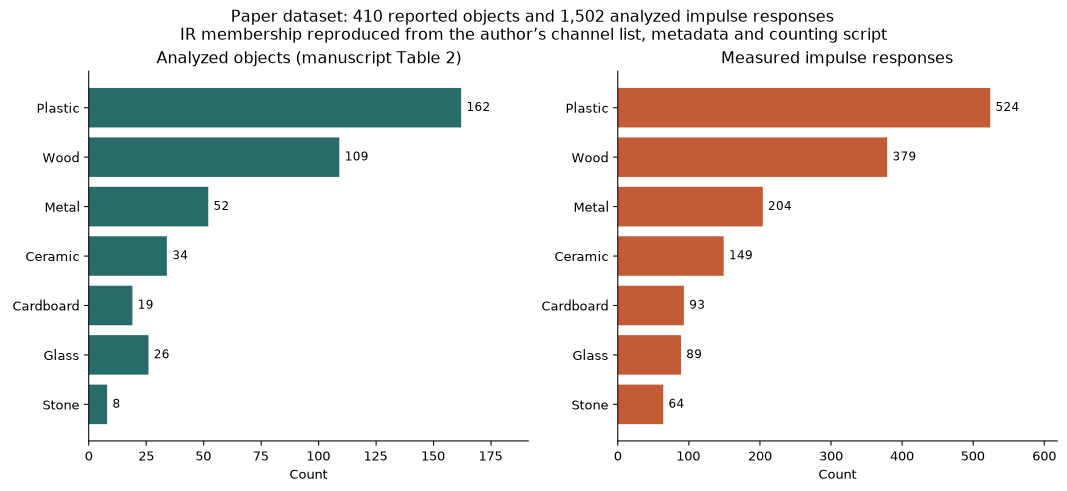
Material coverage

Study material groups. Click a material to explore its selected recordings.

IR counts are computed from the selected channel list. Object counts come from manuscript Table 2. Original material labels remain in the CSV.

PAPER REFERENCE COHORT

The study behind
the collection.

1,502 analyzed IRs

The manuscript reports 497 measured objects, with 410 objects retained across seven materials. Analyzed IRs passed a relative noise-floor criterion of −30 dB.

Analyzed objects by material and size, transcribed from the manuscript

The 1,502 channel paths reproduce the selection in count_objects.m. The 410 object counts above are transcribed directly from manuscript Table 2.

Materials × size

Number of objects in each material and size category, exactly as reported in manuscript Table 2.

Download CSV ↗

02 / EXPLORE & LISTEN

Objects, in resonance.

Open a recording to compare its microphone channels, inspect its waveform and spectrum, and download the original response.

03 / MEASUREMENT & PROVENANCE

From an object
to its impulse response.

A contact speaker excites the object with Golay sequences. Contact microphones record the response at different surface positions. Cross-correlation with the input yields snapshots; their average forms the measured response, h(t).

Each channel is a distinct speaker–microphone measurement. The study used 4–8 microphones where space allowed; older recording sets in this archive also contain two-channel entries.

01

Original measurements preserved

Only the paper’s 1,502 selected h.wav files are included. Membership is reproduced from the author’s original channel list, metadata lookup, and seven material rules. Snapshots, synthesized responses, calibration files, and other materials are excluded. Downloads preserve the original bytes; SHA256 hashes are included.
02

Listen with context

Audio previews are peak-normalized to 70% full scale and include 150 ms of trailing silence. These are contact impulse responses, not recordings of a natural strike. Absolute playback level does not represent object loudness.

03

Labels and photographs

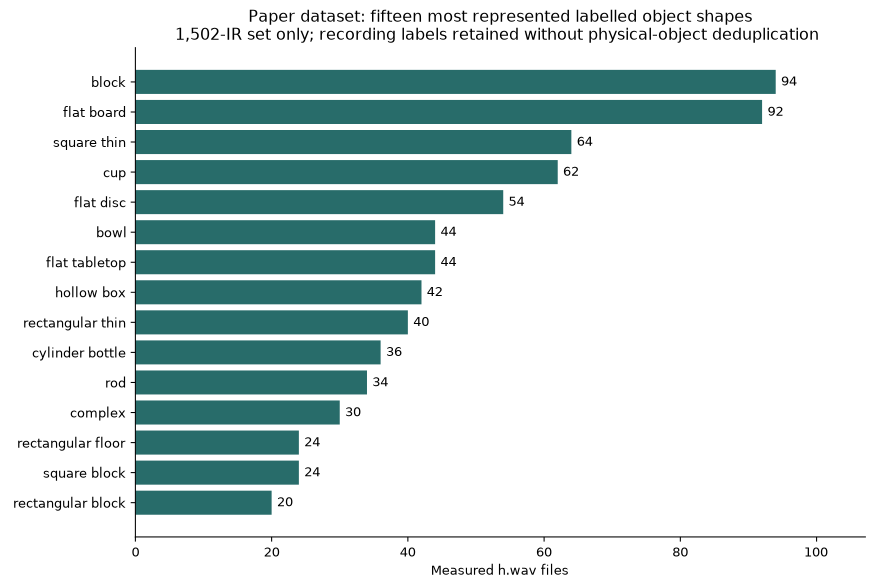
Material, shape, size, and object-name fields come from the recording metadata; missing shape and dimension fields are supplemented by exact-directory Meta.txt files where available. Study material grouping follows the author’s substring rules, so labels such as composite_wood enter the wood category; their original labels remain visible. Photographs are linked by exact recording ID; missing images are shown explicitly. Web copies are resized and omit EXIF metadata.

04

What still needs reconciliation

The selected files map to 411 recording IDs, while manuscript Table 2 reports 410 objects. Some metadata rows repeat recording names; the first matching row is used, following the analysis code. Physical-object identity reconciliation has not been guessed.

ARCHIVE HEALTH

The paper selection, traced.

04 / TAKE THE DATA WITH YOU

Made to explore.
Ready to analyze.

Use the original WAV files, browse the metadata, or export a figure for a presentation. The CSV tables record exactly what each count represents.

No new distribution license is asserted here. Contact the authors regarding reuse and citation.

RECORDING DETAIL